
There is always an explanation, but none of them gives you your money back.

Inflation is going up again.
In July, UK CPI rose to 2.9% from 2.6% in June. CPIH rose to 3.1%, from 2.8%. Household gas prices jumped 14.7% in a single month.
The explanation this time is higher wholesale energy prices following the conflict in the Middle East. That may be true. It is also beside the point for the person paying the bill.
There is always something.
Covid. Ukraine. Broken supply chains. Political decisions. Tax changes. Bad weather. War.
The cause changes. The impact does not: the pound in your pocket buys less.
The rate can fall while the damage grows
When inflation falls, prices do not fall. They continue to rise, just more slowly. A cut from 10% inflation to 3% is not prices coming down. It is another 3% added to a price level that has already been pushed much higher.
Over the five years from July 2021 to July 2026, the Retail Prices Index rose 37.2%. What cost £100 then costs about £137.18 now.
A £100 cash balance earning nothing still says £100. It feels untouched. In purchasing-power terms, it is worth only about £72.90 in July 2021 money.
That is why inflation is so dangerous. A market fall announces itself in red ink. Inflation takes the money without changing the number on the statement.
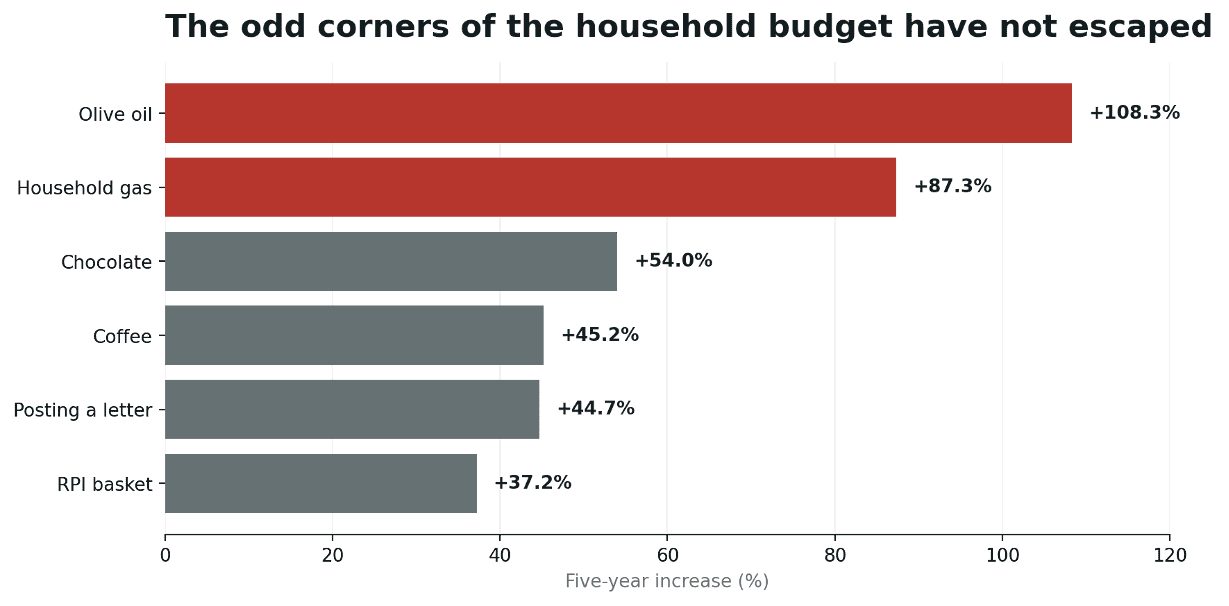
Some of the rises are almost absurd
Olive oil has more than doubled. Chocolate is up 54%. The cost of postal services, the humble act of sending something through the post, is up nearly 45%. Coffee is up about 45%. Household gas is up 87%.
These are not luxury yachts or obscure financial instruments. They are the ordinary, forgettable purchases woven through daily life. That is precisely how inflation does its work: a little here, a lot there, every week, for years.
Cash is not risk-free. It just hides the risk.
Cash is essential for emergencies, planned spending and peace of mind.
But holding long-term wealth in cash because the balance does not move is not the removal of risk. It is a deliberate exposure to the risk that your money will buy less every year.
Ownership is the only credible long-term defence
Prices keep going up; savers need to become investors and own assets capable of repricing too.
That means real and productive assets: shares in businesses that can grow earnings and raise prices, property that can generate rents, infrastructure linked to economic activity, and other scarce assets whose value is not fixed in pounds.
Not every real asset will beat inflation. None comes with a guarantee. Property can fall. Equities can fall sharply. Infrastructure and commodities can disappoint. Diversification matters.
But these assets at least have the ability – the chance – to grow income and value faster than the cost of living. Cash does not.
Volatility is not the enemy
The price of admission is volatility. If you want a realistic chance of beating inflation, you must accept that the value of your portfolio will move and will sometimes move against you.
It is the feature that allows long-term investors to own productive assets rather than a fixed promise denominated in a currency that steadily loses purchasing power.
Cash may never produce a frightening statement, but it quietly guarantees that your lifestyle becomes more expensive than your money can support.
A final thought
There will always be a reason for the next price rise. The reason may be legitimate, temporary or entirely beyond your control. Your financial plan still has to survive the consequences.
Inflation does not need a crisis to keep working. It only needs time.