
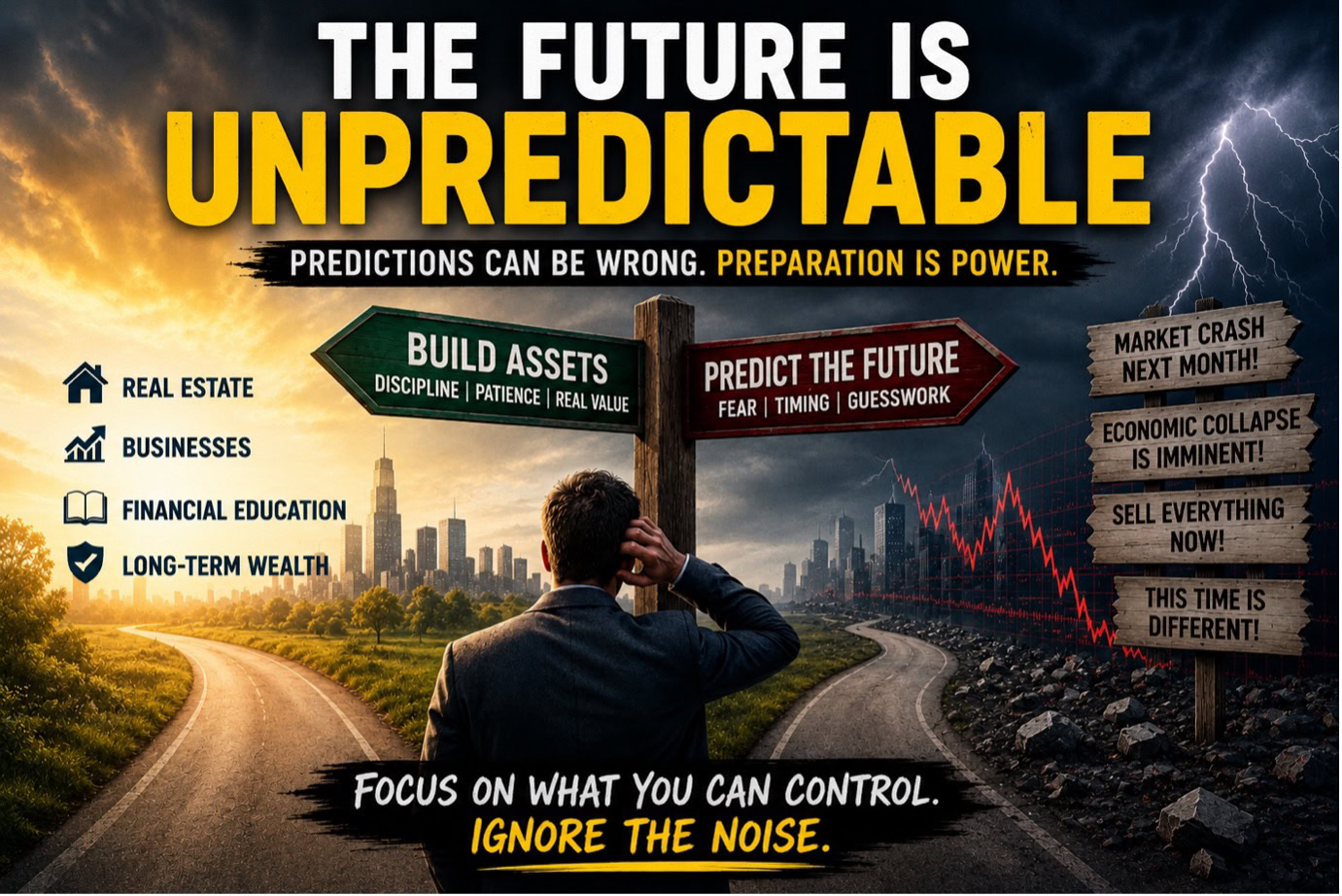
Why even the smartest people get it wrong
If there is one lesson that investing has taught me over the years, it is this:
Nobody knows what happens next.
Not central bankers. Not economists. Not politicians. Not investment managers. Not bestselling authors. And certainly not the endless parade of experts who confidently appear on television, podcasts and social media predicting what markets will do next.
That may sound obvious, but investors repeatedly forget it.
We are naturally drawn to certainty. We like people who sound confident. We want someone to tell us what is about to happen and how we can profit from it.
The problem is that the future has a habit of humiliating even the most intelligent forecasters.
Robert Kiyosaki: Right on Principles, Wrong on Timing?
Take Robert Kiyosaki, author of Rich Dad Poor Dad.
Before I go any further, I should say that I agree with many of his core principles.
I agree that:
- Building assets is preferable to accumulating liabilities.
- Financial education is lacking in most school systems.
- Excessive government debt is a genuine concern.
- Persistent money printing can erode purchasing power.
- Inflation is a hidden tax that damages savers.
- Real assets such as property, businesses (shares) and productive investments play a critical role in preserving wealth.
Where I part company is on the repeated attempts to predict exactly when the next great financial collapse will occur.
Over the past two decades, Kiyosaki has repeatedly warned that the biggest stock market crash in history is imminent.
The problem?
The predicted crash keeps moving.
Markets have certainly experienced corrections, bear markets and periods of significant volatility. Yet investors who had exited equities every time a major crash was predicted would have missed one of the greatest wealth-creation periods in history.
This highlights a critical distinction:
You can be broadly right about risks while being completely wrong about timing.
And in investing, timing matters enormously.
The Graveyard of Expert Predictions
Robert Kiyosaki is far from alone.
History is littered with famous predictions that turned out to be spectacularly wrong.
Thomas Watson – IBM
In 1943, Thomas Watson, chairman of IBM, reportedly said:
“I think there is a world market for maybe five computers.”
Today, there are billions of computing devices worldwide.
A prediction that seemed reasonable at the time now appears absurd.
Irving Fisher
One of the most respected economists of his generation.
Just before the 1929 Wall Street Crash, Fisher declared:
“Stock prices have reached what looks like a permanently high plateau.”
Days later, the market collapsed.
Even brilliant economists can be catastrophically wrong.
Paul Ehrlich
In 1968, Ehrlich predicted mass starvation and resource collapse due to overpopulation.
While global challenges certainly remain, agricultural innovation has dramatically increased food production, and many of the dire forecasts never materialised.
The Y2K Apocalypse
As the year 2000 approached, many experts predicted widespread societal disruption from computer systems failing.
Companies spent billions preparing.
Midnight arrived.
Most people just kept partying and noticed very little.
The Endless Recession Forecasts
Every year, economists predict an imminent recession.
Eventually, one of them is correct.
The challenge is that investors who acted on every recession prediction would likely have spent most of their lives sitting in cash.
Why Forecasting Fails
The future is not a maths equation.
Markets are complex adaptive systems involving billions of decisions made by individuals, businesses, governments and institutions.
Nobody can accurately model:
- Political events
- Wars
- Technological breakthroughs
- Consumer behaviour
- Pandemics
- Regulatory changes
- Investor psychology
The number of variables is effectively infinite.
This is why precise forecasts fail.
The further into the future somebody predicts, the less reliable the prediction becomes.
Yet ironically, the more dramatic the forecast, the more attention it receives.
Nobody clicks on a headline saying:
“Markets may experience a range of possible outcomes over the next decade.”
But they will click on:
“Biggest crash in history starts next month!”
Fear sells.
Certainty sells.
Reality is usually much messier.
The Cost of Acting on Predictions
The danger is not merely that predictions are wrong.
The danger is what investors do because of those predictions.
I’ve met people who:
- Stayed in cash for years waiting for a crash.
- Sold investments after reading a scary headline.
- Delayed retirement planning because they feared economic collapse.
- Missed significant market gains while waiting for the “perfect” entry point.
The irony is that the greatest risk for many investors is not market volatility.
It is failing to participate in long-term growth.
Missing just a handful of the market’s strongest days can dramatically reduce long-term returns.
Unfortunately, those strong days often occur shortly after the worst days.
Which means investors who attempt to jump in and out frequently get both decisions wrong.
What Should Investors Do Instead?
Accept uncertainty.
That may sound unsatisfying, but it is actually liberating.
Rather than trying to predict the future, focus on what you can control:
- Spending habits
- Savings rates
- Diversification
- Asset allocation
- Tax efficiency
- Investment costs
- Behaviour during market declines
Successful investing is rarely about forecasting.
It is usually about discipline.
The investors who achieve the best long-term outcomes are often not those with the highest IQs or the most sophisticated predictions.
They are the people who build sensible plans and stick to them through uncertainty.
The Humility Advantage
One of the most valuable phrases in investing is:
“I don’t know.”
The moment somebody becomes absolutely certain about the future, caution is warranted.
Markets have a remarkable ability to embarrass both optimists and pessimists.
The future will almost certainly surprise all of us.
Robert Kiyosaki may ultimately be right that excessive debt and money creation create significant long-term risks.
Many respected economists share those concerns.
But recognising risks is very different from predicting dates.
History teaches us that the world’s smartest people consistently fail to forecast the future with precision.
As investors, perhaps the wisest approach is not to seek prophets.
Instead, we should build plans robust enough to survive whatever the future delivers.
Because in the end, successful investing is not about knowing what will happen next.
It’s about being prepared for the fact that none of us truly do.